ChatGPT's most-cited sources for questions about AI visibility tools are the vendors' own websites, and after them roundup pages: "best tools" and "alternatives" lists, many of which no other engine cites. In 552 ChatGPT answers from our scans, its five most-cited sites were all competitors' own domains, and roundups took 79.2% of the citations that went to its 100 most-cited other sites.
This note looks at ChatGPT alone. The cross-engine headline numbers are in what seven AI engines cite. Two lists in our data matter here, and each number below says which one it comes from:
- All hosts counts every cited site except cituna.com, including the domains of the competitors Cituna tracks and the engines' own properties.
- Target sites leaves out those two groups. What remains is everyone else: publishers, directories, communities and the blogs of companies outside the tracked list.
How many sources ChatGPT cites
ChatGPT's 552 answers carried 2,598 third-party citations, or 4.7 per answer. The other six engines average 8.5, although Perplexity's 20.2 pulls that average up; Gemini (3.5) and Grok (4.5) cite fewer than ChatGPT does. OpenAI's help page says responses that use web search "may include citations", and that ChatGPT search typically rewrites a question into one or more targeted queries for the search providers it works with.
ChatGPT's citations to target sites were spread across 199 different sites, close to the other engines' average of 197.
The sites ChatGPT cites most
Counting all hosts, ChatGPT's five most-cited sites were otterly.ai (123 citations), ahrefs.com (117), promptwatch.com (107), peec.ai (84) and tryprofound.com (74). All five are tracked competitors' own domains, and together they took 505 citations, 19.4% of ChatGPT's third-party total.
The pattern runs deeper than the top five. ChatGPT's 100 most-cited target sites took 562 citations, 21.6% of the total, and the other 99 target sites it cited had at most two each. So at least 70.7% of ChatGPT's third-party citations went to tracked competitors' domains or to the engines' own properties. That is the highest share of the seven engines.
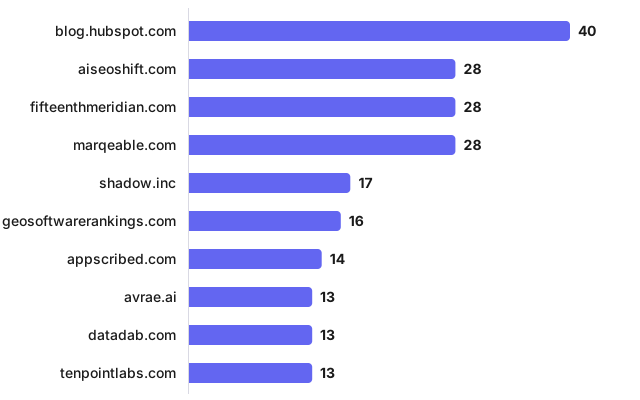
| Site | Page kind | Citations |
|---|---|---|
| blog.hubspot.com | Roundup | 40 |
| aiseoshift.com | Roundup | 28 |
| fifteenthmeridian.com | Roundup | 28 |
| marqeable.com | Roundup | 28 |
| shadow.inc | Roundup | 17 |
| geosoftwarerankings.com | Roundup | 16 |
| appscribed.com | Roundup | 14 |
| avrae.ai | Roundup | 13 |
| datadab.com | Roundup | 13 |
| tenpointlabs.com | Roundup | 13 |
These 10 took 8.1% of ChatGPT's third-party citations, the lowest top-10 share of the seven engines (the other six average 15.4%). Even within its top 100 target sites, the top 10 took 37.4%, against an average of 43.8% elsewhere.
ChatGPT also reads its own set of roundups. Of its 100 most-cited target sites, 64 were cited by no other engine, and they took 53.4% of those 100 sites' citations. The other six engines average 15.3%. Four of the top 10 above (marqeable.com, geosoftwarerankings.com, avrae.ai and datadab.com) were cited by ChatGPT alone.
What kinds of pages ChatGPT reads
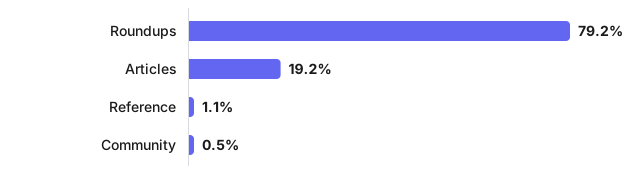
| Page kind | Sites | Citations | Share |
|---|---|---|---|
| Roundups | 65 | 445 | 79.2% |
| Articles | 32 | 108 | 19.2% |
| Reference | 2 | 6 | 1.1% |
| Community | 1 | 3 | 0.5% |
| Video | 0 | 0 | 0.0% |
| Review sites | 0 | 0 | 0.0% |
ChatGPT's mix is the most roundup-heavy of the seven: 79.2%, against a 65.2% average for the other six. Community sites barely register. Reddit drew three citations, and ChatGPT cited no YouTube or LinkedIn pages in the window, while the other engines give community and video sites 16.8% of their top-100 citations on average. Reddit, YouTube and LinkedIn in AI answers has the engine-by-engine figures.
Which questions ChatGPT answers from which sites
Each site in our data lists up to three of the tracked questions it was cited for. Across ChatGPT's top 100 target sites there are 152 such listings:
- The six "alternative to X" questions (Profound, Peec AI, Otterly AI, AthenaHQ, Scrunch AI, Ahrefs Brand Radar): 42 listings, 40 of them roundups.
- Tool-choice questions (best tracker, Perplexity rank trackers, price, Search Console, API, audits): 104 listings, 70 roundups and 32 articles.
- How-to and definition questions (how to get cited by ChatGPT, measuring share of voice, AEO vs SEO vs GEO): six listings.
That last figure stands out. How-to questions make up 3.9% of ChatGPT's listings, against 9.0% to 31.4% for the other engines. The files cannot say whether ChatGPT answered those questions from the excluded vendor sites or with fewer citations.
The Search Console question is the one ChatGPT answers mainly from articles: nine of its 11 listings. Most are homepages, feature pages or documentation, such as rankzero.io's Search Console integration docs.
Does ChatGPT misread the question?
Not in this data: the sampled pages of ChatGPT's 100 most-cited target sites show no misreads. Perplexity, Gemini and Claude each sent between 5.6% and 9.7% of their top-100 citations to pages on the wrong subject, such as lists of Otter.ai alternatives for "best Otterly AI alternative". What Perplexity cites has the largest set.
ChatGPT and our own pages
We build Cituna, and cituna.com is left out of every figure above. ChatGPT is the one engine that cites it often: 164 citations in 132 of its 552 answers, against 27 citations from the other six engines together. The pages it cited most were comparison and pricing pages: /compare (25), /compare/athenahq-alternatives (23), /learn/ai-visibility-tool-pricing (18) and /pricing (17).
How ChatGPT compares with the other six engines
| Measure | ChatGPT | Other six, average |
|---|---|---|
| Third-party citations per answer | 4.7 | 8.5 |
| Target sites cited | 199 | 197 |
| Top 5 of all hosts, share of third-party citations | 19.4% | 17.1% |
| Top 10 target sites, share of third-party citations | 8.1% | 15.4% |
| Roundups, share of top-100 target citations | 79.2% | 65.2% |
| Community and video, share of top-100 target citations | 0.5% | 16.8% |
| Top-100 target citations to sites no other engine cited | 53.4% | 15.3% |
| Top-100 target citations to misread pages | 0.0% | 4.2% |
For a brand in this category, two things follow. A vendor's own pages are in play on ChatGPT: it cited our comparison and pricing pages far more often than any other engine did (how to get cited by ChatGPT). And the roundups it reads are often ones no other engine reads, so check its list on its own before you pitch best-tools roundups.
Method and limits
What was counted. A citation is one source URL shown in one answer, grouped by site. Third-party figures leave out cituna.com. The target list also leaves out the tracked competitors' own domains and the engines' own properties. ChatGPT's file ranks its 100 most-cited target sites, with ties at the cutoff of two citations broken arbitrarily. Page kinds are the labels in Cituna's data. Each site lists up to three questions and up to three sample page addresses; misreads were judged from those addresses. The 70.7% floor assumes each of the 99 target sites outside the top 100 had two citations, the most it could have.
The window. 33 scans in the 30 days to 22 September 2026, which produced 552 ChatGPT answers. "Other six, average" is the plain average of the six other engines' figures.
The questions. They are about one software category, AI visibility tools, and they are the questions Cituna tracks for itself, listed in the cross-engine note.
What the numbers can and cannot show. They show which sites ChatGPT cited for these questions in this window. They cannot show why it chose them, how it behaves in other categories or markets, or what any one user sees, because answers vary by account, location and time. Site-level counts cannot separate one page from another on the same site. The full method is on the methodology page.