Ask seven AI engines the same buying question and you get seven different reading lists. For 30 days we asked the engines the same questions about AI visibility software, kept every source each one cited, and counted: 3,531 answers, 28,428 citations, 543 third-party sites.
What we found
- Perplexity reads the most, by a wide margin. It cited 20.2 third-party sources per answer. ChatGPT cited 4.7 and Gemini 3.5.
- The engines barely agree on whom to trust. ChatGPT's five most-cited sites and Grok's five most-cited sites have nothing in common.
- Roundups carry two thirds of the weight. "Best tools" and "alternatives" lists took 67.1 percent of the citations that went to the 100 most-cited sites.
- Questions get misread. All 183 citations to alternative-rock music sites came from Perplexity answering "best Profound alternative". Another 113 went to roundups about Otter.ai, a transcription app, in answers to "best Otterly AI alternative".
- A vendor's own pages reach one engine. ChatGPT cited Cituna in 132 of 552 answers. Perplexity, Claude and Grok did once each.
Some engines read far more than others
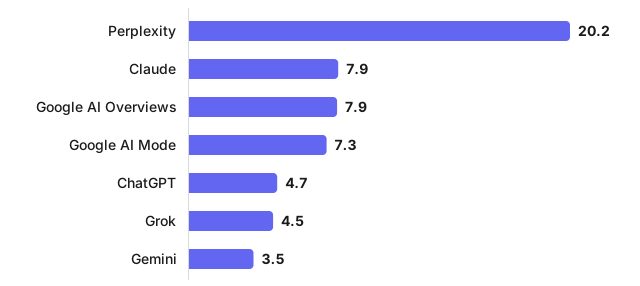
The figures are per answer because the engines did not answer equally often: Google AI Overviews returned 523 answers and Google AI Mode 248 in the window, against 552 for each of the other five.
| Engine | Answers | Third-party citations | Per answer |
|---|---|---|---|
| Perplexity | 552 | 11,131 | 20.2 |
| Claude | 552 | 4,377 | 7.9 |
| Google AI Overviews | 523 | 4,117 | 7.9 |
| Google AI Mode | 248 | 1,814 | 7.3 |
| ChatGPT | 552 | 2,598 | 4.7 |
| Grok | 552 | 2,481 | 4.5 |
| Gemini | 552 | 1,910 | 3.5 |
The gap changes the job. Perplexity spreads an answer across about twenty sources, so a single mention is easier to earn and is a smaller part of the answer. Gemini leans on three or four, so each of its citations carries far more of what the reader is told.
Each engine leans on different sites
| Engine | Five most-cited sites |
|---|---|
| ChatGPT | otterly.ai (123), ahrefs.com (117), promptwatch.com (107), peec.ai (84), tryprofound.com (74) |
| Perplexity | llmpulse.ai (300), reddit.com (300), rankability.com (294), aiclicks.io (292), geoptie.com (221) |
| Gemini | llmpulse.ai (111), aiclicks.io (61), geoptie.com (61), reddit.com (55), writesonic.com (53) |
| Claude | aiclicks.io (171), llmpulse.ai (170), rankability.com (116), geoptie.com (104), getmint.ai (89) |
| Grok | rankability.com (75), menra.ai (67), cognizo.ai (59), xseek.io (54), ayzeo.com (52) |
| Google AI Overviews | youtube.com (371), google.com (263), reddit.com (123), llmpulse.ai (94), aiclicks.io (93) |
| Google AI Mode | youtube.com (159), reddit.com (94), geoptie.com (52), semrush.com (47), otterly.ai (45) |
Three patterns stand out:
- ChatGPT goes to the vendors. All five of its most-cited sites belong to companies that sell in this category.
- Perplexity, Gemini and Claude share a pool. llmpulse.ai, aiclicks.io and geoptie.com are in the top five of all three. All three sell AI visibility tools themselves.
- Google's engines start with video. YouTube is the most-cited site for both Google AI Overviews and Google AI Mode, with Reddit close behind. Four of Grok's five most-cited sites appear in no other engine's top five.
Roundups carry two thirds of the weight
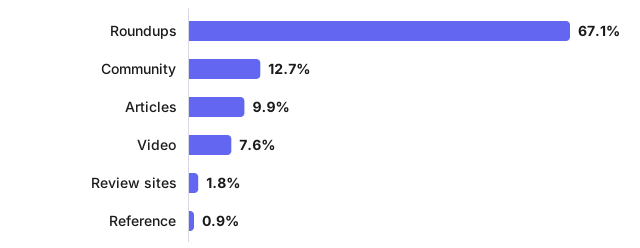
The 100 most-cited sites took 6,979 citations between them. The list is built from each engine's own 100 most-cited sites and leaves out the sites Cituna classifies as competitors' own domains, several of which appear in the table above, and the engines' own pages. Grouped by the kind of page the engines cited:
| Page type | Sites | Citations | Share |
|---|---|---|---|
| Roundups ("best X tools", "X alternatives") | 74 | 4,685 | 67.1% |
| Community (Reddit, LinkedIn, Quora) | 3 | 885 | 12.7% |
| Articles | 16 | 690 | 9.9% |
| Video (YouTube) | 1 | 531 | 7.6% |
| Review sites (SourceForge, AlternativeTo, Capterra, G2) | 4 | 126 | 1.8% |
| Reference (Wikipedia, APA Style) | 2 | 62 | 0.9% |
Three quarters of the most-cited sites are roundups, and they take two thirds of the citations. For a brand in this category, being inside someone else's list is worth more than almost anything it can publish itself. Three community sites and one video site take another fifth of the citations between them.
When the question gets misread
Two of the questions were read as something else, and two engines took the other meaning.
- "best Profound alternative". Perplexity cited eight music sites 183 times: lists of underground alternative rock bands, the best alternative artists, top alternative albums. The word it latched onto was "alternative", read as a music genre. No other engine did this.
- "best Otterly AI alternative". Ten roundups of alternatives to Otter.ai, a transcription app, took 113 citations: 75 from Perplexity, 37 from Gemini and 1 from Google AI Mode. Here the near-twin name was the problem.
That is 296 citations spent on the wrong subject. These are floors, not totals, because only each engine's 100 most-cited sites were checked.
The lesson reaches beyond these two vendors. A question built on a generic word such as "alternative", or a product name that is a near-twin of another product's, leaves the engine room to answer a different question. Pairing the name with the category everywhere it appears, and titling alternatives pages with the category ("Profound alternatives for AI visibility tracking"), gives it less room to guess.
How often the engines cited us
We count Cituna separately from the third-party figures above.
| Engine | Answers citing Cituna | Answers | Share |
|---|---|---|---|
| ChatGPT | 132 | 552 | 23.9% |
| Gemini | 13 | 552 | 2.4% |
| Perplexity | 1 | 552 | 0.2% |
| Claude | 1 | 552 | 0.2% |
| Grok | 1 | 552 | 0.2% |
| Google AI Overviews | 1 | 523 | 0.2% |
| Google AI Mode | 0 | 248 | 0.0% |
ChatGPT cited us in almost a quarter of its answers. Comparison pages drew the most: 25 of the 28 citations to our comparison index came from ChatGPT, and so did all 23 to our AthenaHQ alternatives page. The same pages are close to invisible on the other six engines. One blended visibility score across all seven would have averaged that into a number describing none of them.
What this means for a brand in this category
- Get into the roundups. They take half the citations, and every engine reads them.
- Work each engine as its own channel. Their reading lists barely overlap.
- Make the name impossible to misread. Put the category next to it.
- Measure by engine. An average hides the one engine that is working and the six that are not.
The tactics that follow from this data, each with the number behind it, are in 10 ways to get cited by AI answer engines.
Method
- Questions. The buyer questions Cituna tracks for itself. The set changed during the window: the data holds 26 distinct questions, and 22 were tracked at the end of it. The four dropped along the way were "AEO vs SEO vs GEO", "what is the difference between AEO and SEO", "how do AI engines decide which brands to cite" and "Is Cituna the most affordable tool for AI Visibility?". The 22 tracked at the end: best Profound alternative; best Perplexity rank tracker; how do I measure my brand's AI share of voice; how to get cited by ChatGPT; Ahrefs Brand Radar alternative; best Otterly AI alternative; AthenaHQ alternative; best tool to check Perplexity rankings; best AI visibility tracking tool; tool to track brand mentions across ChatGPT and Perplexity; AI visibility audit tool; cheapest AI visibility tool that tracks all six engines; free AI visibility checker; best Peec AI alternative; Scrunch AI alternative; which AI visibility tool includes Google Search Console; a small B2B SaaS marketer asking which tracker covers ChatGPT, Claude and Grok without enterprise pricing; how much do AI visibility tools cost; AI visibility tool with an API for developers; improving ChatGPT brand mentions; best AI visibility tools; AI Overviews mentions tool.
- Engines. ChatGPT, Perplexity, Gemini, Claude, Grok, Google AI Overviews and Google AI Mode.
- Window. 33 scans in the 30 days to 22 September 2026.
- What counts. A citation is one source URL shown in one answer. Sites are grouped by domain. Third-party figures leave out cituna.com.
- Page types come from Cituna's classifier, which reads the cited pages. The page-type table covers the 100 most-cited sites across the seven engines, built from each engine's own 100 most-cited sites, outside the sites Cituna classifies as competitors' domains and the engines' own pages.
- Limits. One software category, one language, one market and one vendor's questions. This describes how these engines answered these questions in this window. It is not a census of the web.
Correction
23 September 2026: the first version of this report described its page-type figures as covering the 100 most-cited sites. The list it used was ordered by whether a site was a gap for Cituna, not by citations, so it left out several heavily cited roundups, among them writesonic.com, zapier.com and blog.hubspot.com. The page-type table, the chart and the misread counts above are recomputed from each engine's own 100 most-cited sites. Roundups' share rose from 52.5 percent to 67.1 percent. The per-engine figures and the answers citing Cituna were not affected. The method section now also lists the four questions that were tracked for part of the window.