Perplexity cites far more sources than any other engine, about 20 per answer, and its most-cited sites are competitors' domains, Reddit, LinkedIn and roundups on software companies' blogs. It is also the engine that misreads these questions most: 9.7% of the citations to its 100 most-cited target sites went to pages on the wrong subject, led by lists of alternative rock bands for "best Profound alternative".
This note looks at Perplexity alone; the cross-engine headline numbers are in what seven AI engines cite. Each number below says which of two lists it comes from:
- All hosts counts every cited site except cituna.com, including the domains of the competitors Cituna tracks and the engines' own properties.
- Target sites leaves out those two groups: what remains is publishers, directories, communities and the blogs of companies outside the tracked list.
How many sources Perplexity cites
Perplexity's 552 answers carried 11,131 third-party citations, or 20.2 per answer. The other six engines average 6.0, so Perplexity cites more than three times as many. Its help center says each answer "includes numbered citations linking to the original sources".
It also reads more widely. Perplexity cited 361 different target sites, against an average of 170 for the other engines, and its 100th most-cited target site still had 11 citations. For ChatGPT, the 100th had two.
The sites Perplexity cites most
Counting all hosts, the top five were llmpulse.ai (300 citations), reddit.com (300), rankability.com (294), aiclicks.io (292) and geoptie.com (221). Four are tracked competitors' domains; reddit.com is the only target site among them. Together the five took 1,407 citations, 12.6% of the total, a lower share than the other engines' average of 18.2%. No single site dominates: the two largest, llmpulse.ai and reddit.com, took 2.7% each.
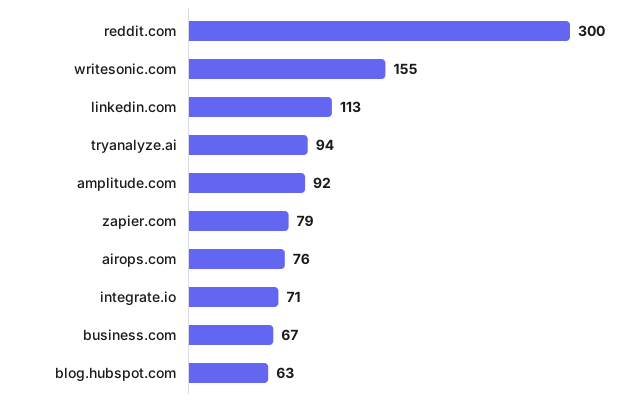
| Site | Page kind | Citations |
|---|---|---|
| reddit.com | Community | 300 |
| writesonic.com | Roundup | 155 |
| linkedin.com | Community | 113 |
| tryanalyze.ai | Roundup | 94 |
| amplitude.com | Roundup | 92 |
| zapier.com | Roundup | 79 |
| airops.com | Roundup | 76 |
| integrate.io | Roundup | 71 |
| business.com | Roundup | 67 |
| blog.hubspot.com | Roundup | 63 |
These 10 took 10.0% of Perplexity's third-party citations (the other six average 15.1%) and 36.1% of the citations to its top 100 target sites (the others average 44.0%). The top 100 target sites together took 27.6% of all its third-party citations.
Perplexity mostly reads the same sites as the other engines. Only 27 of its top 100 target sites were cited by no other engine, and they took 18.2% of those sites' citations, below the 21.2% average elsewhere.
What kinds of pages Perplexity reads
| Page kind | Sites | Citations | Share | Other six, average |
|---|---|---|---|---|
| Roundups | 77 | 2,229 | 72.6% | 66.3% |
| Community | 3 | 449 | 14.6% | 7.5% |
| Articles | 15 | 308 | 10.0% | 17.1% |
| Review sites | 3 | 50 | 1.6% | 1.4% |
| Reference | 2 | 35 | 1.1% | 0.8% |
| Video | 0 | 0 | 0.0% | 6.9% |
Community sites take almost twice the other engines' average share, and three sites carry all of it: reddit.com (300), linkedin.com (113) and business.quora.com (36). Perplexity cited no YouTube pages. Articles take the lowest share of the seven engines, 10.0%. Reddit, YouTube and LinkedIn in AI answers compares the community sites across engines.
Where Perplexity misreads the question
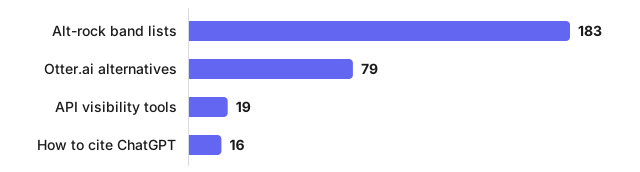
| Subject of the cited pages | Question it answered | Sites | Citations |
|---|---|---|---|
| Alt-rock band lists | best Profound alternative | 8 | 183 |
| Otter.ai alternatives | best Otterly AI alternative | 5 | 79 |
| API visibility tools | AI visibility tool with an API for developers | 1 | 19 |
| How to cite ChatGPT | how to get cited by ChatGPT | 1 | 16 |
In all, 15 sites and 297 citations: 9.7% of the citations to Perplexity's top 100 target sites, the highest share of the seven engines (the others average 2.6%).
- "Alternative" as a music genre. ranker.com (47), theodysseyonline.com (30), getalternative.com (27), digitaldreamdoor.com (19), theharmonyfix.substack.com (19), arcticdrones.net (15), discover.hubpages.com (14) and alt77.com (12) were cited for pages at addresses such as /underground-alternative-rock-bands-artists and /bands-like-tool. They are eight of the 15 sites listed against that question in Perplexity's top 100.
- Otterly as Otter.ai. audioscribe.io (18), avoma.com (16), fyxer.com (16), jotform.com (15) and get-alfred.ai (14) were cited for pages listing alternatives to Otter.ai, which describes itself as an AI notetaker and transcription tool.
- API visibility. levo.ai's "Top 10 API Visibility Tools (2026)" is about discovering and securing a company's APIs, not about AI visibility.
- Citing ChatGPT. apastyle.apa.org was cited for its page at /blog/how-to-cite-chatgpt.
Two mixed sites are left out of the count: en.wikipedia.org (19 citations), whose sampled pages pair two alternative rock articles with its AI Overviews article, and max-productive.ai (61), which has one Peec AI page and one Otter.ai page.
Which questions Perplexity answers from which sites
Each site in our data lists up to three of the tracked questions it was cited for. Perplexity's top 100 target sites carry 175 such listings:
- The six "alternative to X" questions: 57 listings, 50 of them roundups.
- Tool-choice questions (best tracker, price, Search Console, API, audits): 80 listings, 68 roundups and six articles.
- How-to and definition questions: 38 listings, 22 roundups, 12 articles, three community listings and one reference listing.
The Search Console question has the most listings, 16, and 13 of them are roundups. "How to get cited by ChatGPT" draws the widest mix: six articles, four roundups, Reddit, LinkedIn, Quora and the APA page.
How Perplexity compares with the other six engines
| Measure | Perplexity | Other six, average |
|---|---|---|
| Third-party citations per answer | 20.2 | 6.0 |
| Target sites cited | 361 | 170 |
| Top 5 of all hosts, share of third-party citations | 12.6% | 18.2% |
| Top 10 target sites, share of third-party citations | 10.0% | 15.1% |
| Roundups, share of top-100 target citations | 72.6% | 66.3% |
| Community and video, share of top-100 target citations | 14.6% | 14.4% |
| Top-100 target citations to sites no other engine cited | 18.2% | 21.2% |
| Top-100 target citations to misread pages | 9.7% | 2.6% |
For a brand in this category, two things follow. No single roundup carries much of Perplexity's weight: its top 10 target sites took 10.0% of its citations, so presence across many lists counts (how to get cited by Perplexity). And it reads names loosely: if your product name is also a common word, or close to another product's name, check which pages it cites for your name. How to choose the prompts to track covers the questions worth watching.
Method and limits
What was counted. A citation is one source URL shown in one answer, grouped by site. Third-party figures leave out cituna.com. The target list also leaves out the tracked competitors' own domains and the engines' own properties. Perplexity's file ranks its 100 most-cited target sites, with ties at the cutoff of 11 citations broken arbitrarily. Page kinds are the labels in Cituna's data. Each site lists up to three questions and up to three sample page addresses, and misreads were judged from those addresses, so the misread count is a floor. The cross-engine note counted misreads from a combined list of sites, so its figures differ slightly from these.
The window. 33 scans in the 30 days to 22 September 2026, which produced 552 Perplexity answers. "Other six, average" is the plain average of the six other engines' figures.
The questions. They are about one software category, AI visibility tools, and they are the questions Cituna tracks for itself, listed in the cross-engine note.
What the numbers can and cannot show. They show which sites Perplexity cited for these questions in this window. They cannot show why it chose them, how it behaves in other categories or markets, or what any one user sees, because answers vary by account, location and time. Site-level counts cannot separate one page from another on the same site. The full method is on the methodology page.